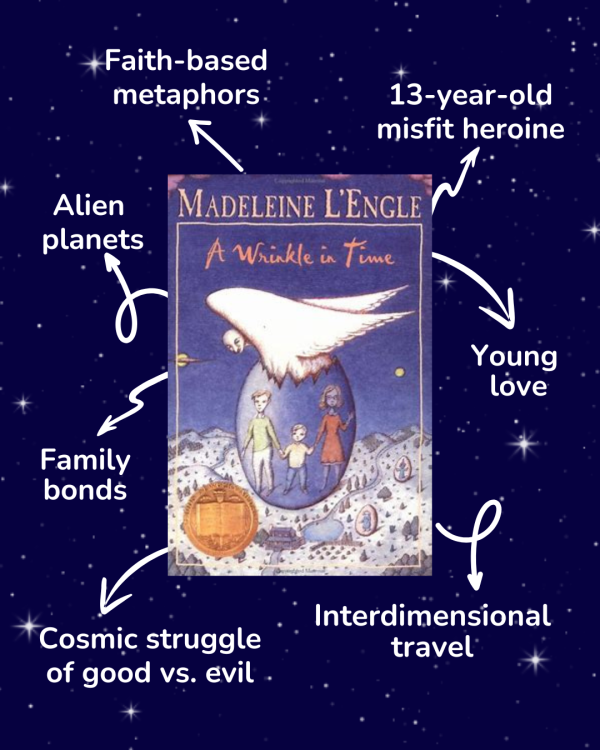
A Wrinkle in Time by Madeleine L’Engle
“I don’t understand it any more than you do, but one thing I’ve learned is that you don’t have to understand things for them to be.”
~A Wrinkle in Time
Meg Murry is miserable. She’s struggling in school, people make fun of her little brother, Charles Wallace, for being “strange,” and worst of all, her scientist father is missing.
Then, one dark and stormy night, she and her family are visited by a mysterious old woman in mismatched clothes. She tells them that she’s been blown off course, but she’ll soon be on her way, and there is such a thing as a tesseract. Thus Meg, Charles Wallace, and their new friend Calvin are pulled into a dimension-hopping adventure to save Meg’s father and the world itself.
A Wrinkle in Time was one of the first sci-fi books I read by myself as a child, and I was enthralled by the otherworldly descriptions and the bravery of Meg and her companions. The way hope stubbornly continued to shine in the face of utter darkness stuck out to me then and, to this day, hope in darkness is a frequent theme in my own writing. So when my kids chose Wrinkle as our most recent read-aloud, I was pleased that they seem to love it as much as I did at their age.
My children never wanted me to stop reading, and when I had to, they peppered me with questions about what was going to happen. “Is Mrs. Whatsit a bad guy?” “Does the Black Thing get Meg?” “Does Charles Wallace escape from IT?” I believe this is truly the largest compliment anyone, kid or grownup, can give a book–not wanting to put it down. When I asked them to rate the book, my daughter (7) gave it five stars, and my son (9) gave it four, hence my combined rating of 4.5 stars.
As a parent, I love that Wrinkle is about the bonds of family that hold true no matter what happens or where you are. The relationship between Charles Wallace and Meg is beautiful, and her parents’ love and unwavering loyalty toward one another show how a strong marriage grounds not just two people but also the family they made together.
There is real science behind the magic of this book, and the fact that it was originally published in 1962 before many of these scientific concepts showed up in popular culture is a testament to Madeleine L’Engle’s brilliance. Multiple dimensions, tesseracts, and the dangers of space are all explored and ignite curiosity in young minds to go learn about the facts behind the fiction.
Finally, the metaphors throughout the book create meaningful subtext that kids can wrap their minds around because of the approachable story. The all encompassing, cold evil of “the Black Thing” warns of the danger of sin. The total authoritarianism of IT and the conformity it demands of its followers show the beauty of God’s gift of free will to his creation. Finally, the way love is the only weapon against this darkness points to eternal truths that form the very fabric of our universe.
Overall rating: ★★★★⯪
Worth reading?: Yes!
Best parts:
– The focus on the unbreakable bonds of family
– How real science is made approachable in the same way “magic” is approachable to kids
– Fantastical other worlds and vivid characters show the power of love over evil
Content concerns: No true concerns. My kiddos (rightly) thought the man with the red eyes was creepy, so maybe don’t read chapter seven right before bedtime.
